
The Age of Craftsmanship
The relationship between technical mastery and the inspiration that gives craftsmanship its purpose.
I have just spent considerable space defending inspiration and its importance. The title of this edition is On Inspiration. And yet here I am, about to place what may appear to be higher importance on craftsmanship. This is not a contradiction. Let me explain why.
In a previous edition, I referenced a quote that I love and very much want readers to sit with. It comes from Dreyfus and Kelly: “The task of a craftsman is not to generate meaning, but rather to cultivate in himself the skill of discerning the meanings that are already there.”
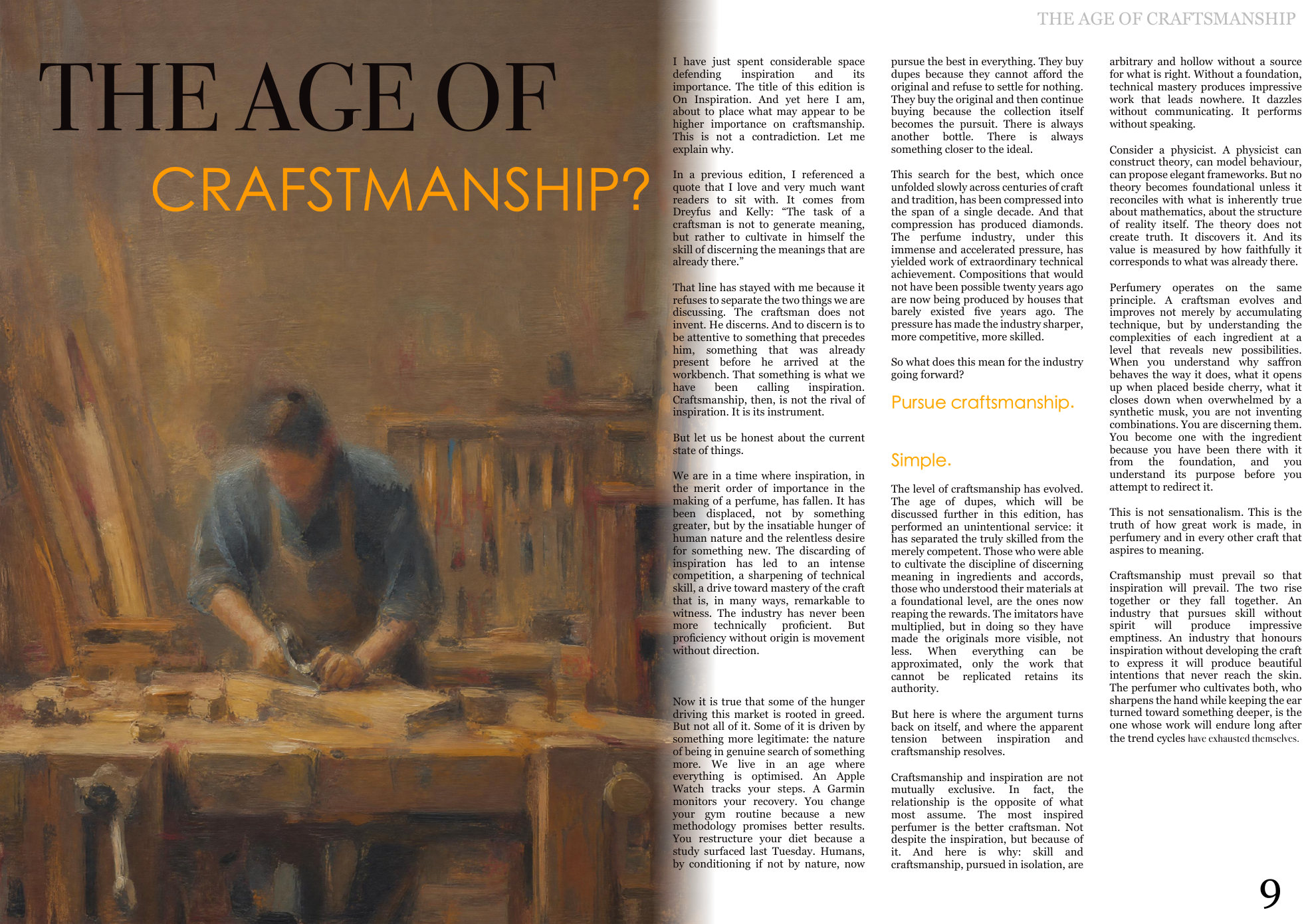
That line has stayed with me because it refuses to separate the two things we are discussing. The craftsman does not invent. He discerns. And to discern is to be attentive to something that precedes him, something that was already present before he arrived at the workbench. That something is what we have been calling inspiration. Craftsmanship, then, is not the rival of inspiration. It is its instrument.
But let us be honest about the current state of things.
We are in a time where inspiration, in the merit order of importance in the making of a perfume, has fallen. It has been displaced, not by something greater, but by the insatiable hunger of human nature and the relentless desire for something new. The discarding of inspiration has led to an intense competition, a sharpening of technical skill, a drive toward mastery of the craft that is, in many ways, remarkable to witness. The industry has never been more technically proficient. But proficiency without origin is movement without direction.
Now it is true that some of the hunger driving this market is rooted in greed. But not all of it. Some of it is driven by something more legitimate: the nature of being in genuine search of something more. We live in an age where everything is optimised. An Apple Watch tracks your steps. A Garmin monitors your recovery. You change your gym routine because a new methodology promises better results. You restructure your diet because a study surfaced last Tuesday. Humans, by conditioning if not by nature, now pursue the best in everything. They buy dupes because they cannot afford the original and refuse to settle for nothing. They buy the original and then continue buying because the collection itself becomes the pursuit. There is always another bottle. There is always something closer to the ideal.
This search for the best, which once unfolded slowly across centuries of craft and tradition, has been compressed into the span of a single decade. And that compression has produced diamonds. The perfume industry, under this immense and accelerated pressure, has yielded work of extraordinary technical achievement. Compositions that would not have been possible twenty years ago are now being produced by houses that barely existed five years ago. The pressure has made the industry sharper, more competitive, more skilled.
So what does this mean for the industry going forward?
Pursue craftsmanship.
Simple.
The level of craftsmanship has evolved. The age of dupes, which will be discussed further in this edition, has performed an unintentional service: it has separated the truly skilled from the merely competent. Those who were able to cultivate the discipline of discerning meaning in ingredients and accords, those who understood their materials at a foundational level, are the ones now reaping the rewards. The imitators have multiplied, but in doing so they have made the originals more visible, not less. When everything can be approximated, only the work that cannot be replicated retains its authority.
But here is where the argument turns back on itself, and where the apparent tension between inspiration and craftsmanship resolves.
Craftsmanship and inspiration are not mutually exclusive. In fact, the relationship is the opposite of what most assume. The most inspired perfumer is the better craftsman. Not despite the inspiration, but because of it. And here is why: skill and craftsmanship, pursued in isolation, are arbitrary and hollow without a source for what is right. Without a foundation, technical mastery produces impressive work that leads nowhere. It dazzles without communicating. It performs without speaking.
Consider a physicist. A physicist can construct theory, can model behaviour, can propose elegant frameworks. But no theory becomes foundational unless it reconciles with what is inherently true about mathematics, about the structure of reality itself. The theory does not create truth. It discovers it. And its value is measured by how faithfully it corresponds to what was already there.
Perfumery operates on the same principle. A craftsman evolves and improves not merely by accumulating technique, but by understanding the complexities of each ingredient at a level that reveals new possibilities. When you understand why saffron behaves the way it does, what it opens up when placed beside cherry, what it closes down when overwhelmed by a synthetic musk, you are not inventing combinations. You are discerning them. You become one with the ingredient because you have been there with it from the foundation, and you understand its purpose before you attempt to redirect it.
This is not sensationalism. This is the truth of how great work is made, in perfumery and in every other craft that aspires to meaning.
Craftsmanship must prevail so that inspiration will prevail. The two rise together or they fall together. An industry that pursues skill without spirit will produce impressive emptiness. An industry that honours inspiration without developing the craft to express it will produce beautiful intentions that never reach the skin. The perfumer who cultivates both, who sharpens the hand while keeping the ear turned toward something deeper, is the one whose work will endure long after the trend cycles have exhausted themselves.
In the original journal
This reading edition follows the published wording and punctuation; line breaks have been reflowed for web reading. The illustrated spreads remain authoritative for the original visual arrangement and typography.
This transcription is provided to make the published Reyach text easier to read and discover. The original edition remains available through the magazine reader. Original spelling is retained, including any errors in the published copy.