
On Inspiration
A defence of meaningful creation, where perfumery encounters philosophy, craft and the work of inspiration.
The etymology of "inspiration" comes from the latin word "inspirare" which means to 'breathe into or blow into'
It felt necessary, in the ending of this writer’s sabbatical, to return to the subject of inspiration.
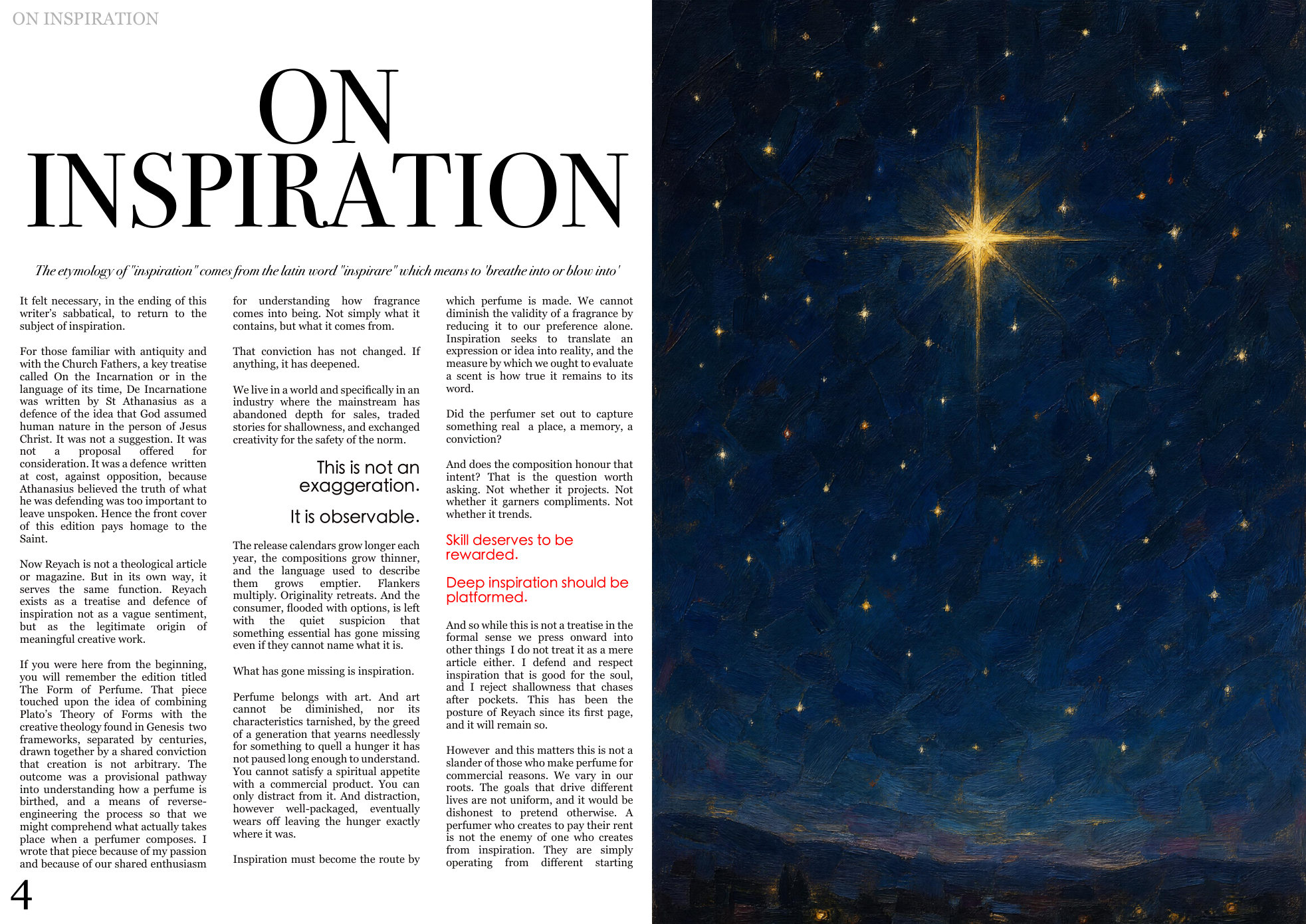
For those familiar with antiquity and with the Church Fathers, a key treatise called On the Incarnation or in the language of its time, De Incarnatione was written by St Athanasius as a defence of the idea that God assumed human nature in the person of Jesus Christ. It was not a suggestion. It was not a proposal offered for consideration. It was a defence written at cost, against opposition, because Athanasius believed the truth of what he was defending was too important to leave unspoken. Hence the front cover of this edition pays homage to the Saint.
Now Reyach is not a theological article or magazine. But in its own way, it serves the same function. Reyach exists as a treatise and defence of inspiration not as a vague sentiment, but as the legitimate origin of meaningful creative work.
If you were here from the beginning, you will remember the edition titled The Form of Perfume. That piece touched upon the idea of combining Plato’s Theory of Forms with the creative theology found in Genesis two frameworks, separated by centuries, drawn together by a shared conviction that creation is not arbitrary. The outcome was a provisional pathway into understanding how a perfume is birthed, and a means of reverse- engineering the process so that we might comprehend what actually takes place when a perfumer composes. I wrote that piece because of my passion and because of our shared enthusiasm for understanding how fragrance comes into being. Not simply what it contains, but what it comes from.
That conviction has not changed. If anything, it has deepened.
We live in a world and specifically in an industry where the mainstream has abandoned depth for sales, traded stories for shallowness, and exchanged creativity for the safety of the norm.
This is not an exaggeration. It is observable.
The release calendars grow longer each year, the compositions grow thinner, and the language used to describe them grows emptier. Flankers multiply. Originality retreats. And the consumer, flooded with options, is left with the quiet suspicion that something essential has gone missing even if they cannot name what it is.
What has gone missing is inspiration.
Perfume belongs with art. And art cannot be diminished, nor its characteristics tarnished, by the greed of a generation that yearns needlessly for something to quell a hunger it has not paused long enough to understand. You cannot satisfy a spiritual appetite with a commercial product. You can only distract from it. And distraction, however well-packaged, eventually wears off leaving the hunger exactly where it was.
Inspiration must become the route by which perfume is made. We cannot diminish the validity of a fragrance by reducing it to our preference alone. Inspiration seeks to translate an expression or idea into reality, and the measure by which we ought to evaluate a scent is how true it remains to its word.
Did the perfumer set out to capture something real a place, a memory, a conviction?
And does the composition honour that intent? That is the question worth asking. Not whether it projects. Not whether it garners compliments. Not whether it trends.
Skill deserves to be rewarded.
Deep inspiration should be platformed.
And so while this is not a treatise in the formal sense we press onward into other things I do not treat it as a mere article either. I defend and respect inspiration that is good for the soul, and I reject shallowness that chases after pockets. This has been the posture of Reyach since its first page, and it will remain so.
However and this matters this is not a slander of those who make perfume for commercial reasons. We vary in our roots. The goals that drive different lives are not uniform, and it would be dishonest to pretend otherwise. A perfumer who creates to pay their rent is not the enemy of one who creates from inspiration. They are simply operating from different starting points, and both deserve the dignity of being understood on their own terms.
"This is a defence of something that is dying. It is not an attack on those who participate in its decline."
The economic state of the world has ushered people, perfumers included into a posture of survival. Needs must be met. Bills must be paid. Families must be fed. No one disputes this. But the consequence is that we rush the finer things.
Now you may be thinking, “this is just sentimentality. Show me what you mean.” And you would be right to ask. What does inspiration-driven perfume actually look like when it is done well? Not in theory. Not as a philosophical exercise. In practice, in a bottle, on skin, in the room.
There are many fragrances that achieve this, and time would cease to exist if I attempted to list them all. So I will choose one. One that I picked up this year, that stopped me, and that has stayed with me since.
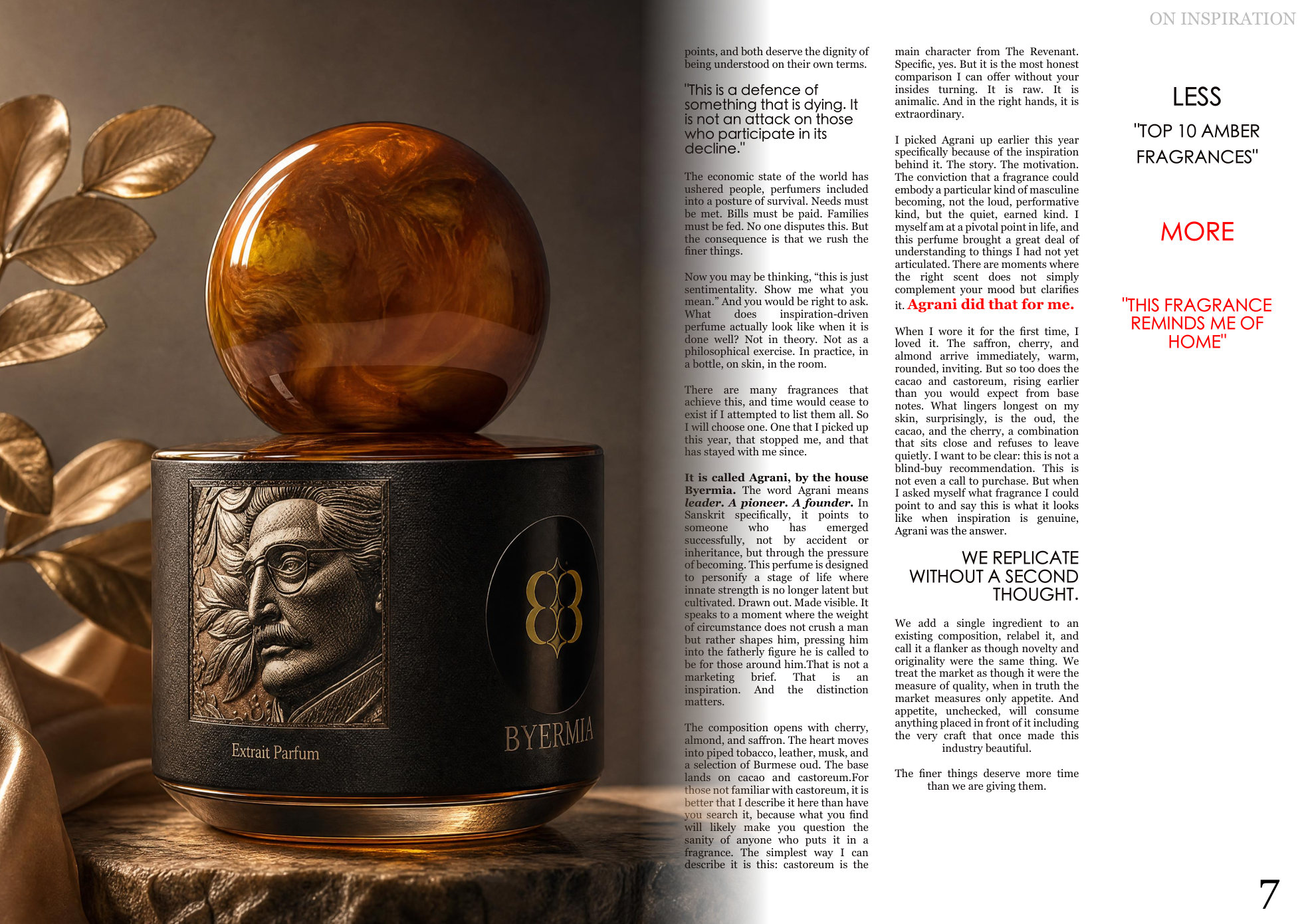
It is called Agrani, by the house Byermia. The word Agrani means leader. A pioneer. A founder. In Sanskrit specifically, it points to someone who has emerged successfully, not by accident or inheritance, but through the pressure of becoming. This perfume is designed to personify a stage of life where innate strength is no longer latent but cultivated. Drawn out. Made visible. It speaks to a moment where the weight of circumstance does not crush a man but rather shapes him, pressing him into the fatherly figure he is called to be for those around him.That is not a marketing brief. That is an inspiration. And the distinction matters.
The composition opens with cherry, almond, and saffron. The heart moves into piped tobacco, leather, musk, and a selection of Burmese oud. The base lands on cacao and castoreum.For those not familiar with castoreum, it is better that I describe it here than have you search it, because what you find will likely make you question the sanity of anyone who puts it in a fragrance. The simplest way I can describe it is this: castoreum is the main character from The Revenant. Specific, yes. But it is the most honest comparison I can offer without your insides turning. It is raw. It is animalic. And in the right hands, it is extraordinary.
I picked Agrani up earlier this year specifically because of the inspiration behind it. The story. The motivation. The conviction that a fragrance could embody a particular kind of masculine becoming, not the loud, performative kind, but the quiet, earned kind. I myself am at a pivotal point in life, and this perfume brought a great deal of understanding to things I had not yet articulated. There are moments where the right scent does not simply complement your mood but clarifies it. Agrani did that for me.
When I wore it for the first time, I loved it. The saffron, cherry, and almond arrive immediately, warm, rounded, inviting. But so too does the cacao and castoreum, rising earlier than you would expect from base notes. What lingers longest on my skin, surprisingly, is the oud, the cacao, and the cherry, a combination that sits close and refuses to leave quietly. I want to be clear: this is not a blind-buy recommendation. This is not even a call to purchase. But when I asked myself what fragrance I could point to and say this is what it looks like when inspiration is genuine, Agrani was the answer.
WE REPLICATE WITHOUT A SECOND THOUGHT.
We add a single ingredient to an existing composition, relabel it, and call it a flanker as though novelty and originality were the same thing. We treat the market as though it were the measure of quality, when in truth the market measures only appetite. And appetite, unchecked, will consume anything placed in front of it including the very craft that once made this industry beautiful.
The finer things deserve more time than we are giving them.
LESS "TOP 10 AMBER FRAGRANCES" — MORE "THIS FRAGRANCE REMINDS ME OF HOME"
In the original journal
This reading edition follows the published wording and punctuation; line breaks have been reflowed for web reading. The illustrated spreads remain authoritative for the original visual arrangement and typography.
This transcription is provided to make the published Reyach text easier to read and discover. The original edition remains available through the magazine reader. Original spelling is retained, including any errors in the published copy.